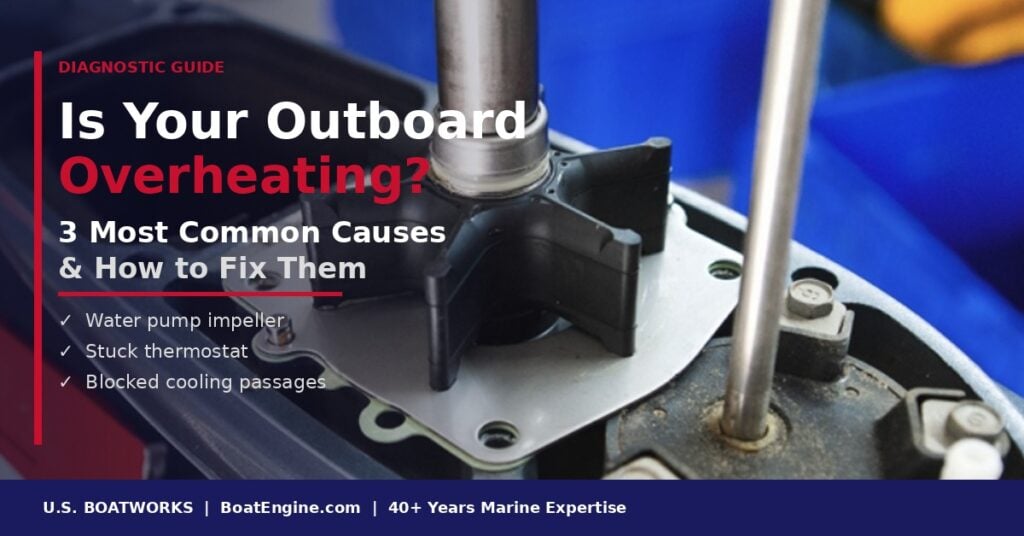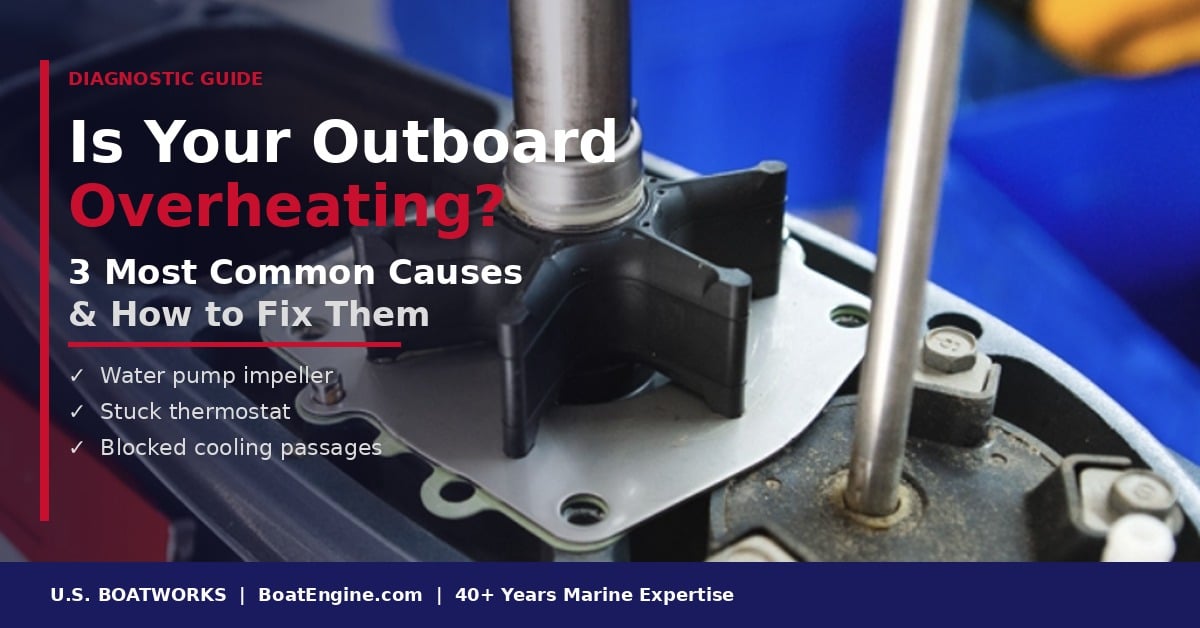





Is Your Mercury Running Hot? Here's How to Find Out Why
If your Mercury outboard is overheating, you're not alone — and you don't need to panic. After 40+ years of marine service, we've diagnosed this hundreds of times. The good news: most overheating problems trace back to a handful of common causes you can check yourself before assuming the worst.
Common Causes of Outboard Overheating:
- Clogged or failed water pump impeller (most common)
- Blocked water intake screens (weeds, mud, debris)
- Stuck or failing thermostat
- Clogged cooling water passages (salt or mineral buildup)
- Damaged or collapsed water tube
Tools Needed: Flashlight, basic hand tools, garden hose with flush attachment
Estimated Time: 15–30 minutes to diagnose, 1–3 hours to fix depending on cause
Signs Your Outboard Is Overheating
Before you start checking parts, confirm you’re actually dealing with overheating and not something else:
- Weak or no “tell-tale” stream (the small water stream out the back of the motor)
- Overheat alarm or warning horn sounding
- Engine goes into reduced-power “limp mode”
- Steam or unusual smell near the engine
- Engine temperature gauge reading high (if equipped)
If your tell-tale stream looks normal and strong, your overheating symptom might actually be something else — check our guide on outboard starting problems instead.
Step 1: Check the Tell-Tale Stream First
This is the fastest way to narrow things down. With the engine running in water (or on flush muffs), look at the small stream of water shooting out the back of the lower cowling.
What you’re looking for:
- Strong, steady stream = water pump is likely fine, problem is downstream (thermostat or passages)
- Weak, sputtering, or no stream = water isn’t reaching the engine — start with the water pump and intake
If You Have a Weak or No Tell-Tale Stream
DIY Difficulty: Intermediate
Time Required: 1–2 hours
Special Tools: None required for inspection; impeller puller helpful but not essential
Parts You’ll Likely Need:
- Water pump impeller kit (model-specific — find yours at our Parts Finder)
- Water pump housing gasket
- Impeller grease
How to Check:
- Trim the motor up and check the water intake screens on the lower unit for weeds, mud, or debris. Clear anything blocking the holes.
- If the screens are clear, the impeller itself is the likely culprit. Impellers wear out from age and dry-running, even if the boat hasn’t been used much.
- Pull the lower unit (or have us do it) to inspect the impeller. Cracked, melted, or missing vanes confirm the diagnosis.
Pro Tip: Impellers should be replaced every 100 hours or annually regardless of appearance — by the time they visibly fail, you’ve usually already done some damage to the water pump housing.
Step 2: Check the Thermostat
If your tell-tale stream is strong but the engine still runs hot, the thermostat is the next most common cause.
DIY Difficulty: Beginner to Intermediate
Time Required: 30–45 minutes
Parts You’ll Need:
- Thermostat (model-specific)
- Thermostat housing gasket
How to Check:
- Locate the thermostat housing on top of the powerhead.
- Remove the housing and inspect the thermostat — if it’s stuck closed, corroded, or doesn’t open when heated in a pot of boiling water, replace it.
- Reinstall with a new gasket and torque to spec.
Common Mistake to Avoid: Don’t run the engine without a thermostat to “fix” overheating — outboards are designed to run with one installed, and removing it can cause its own cooling problems.
Parts You Might Need
- Water Pump Impeller Kit — model-specific, call with serial number if unsure — find it on Parts Finder
- Thermostat — model-specific, always replace rather than remove — find it on Parts Finder
- Water Pump Housing Gasket — replace anytime the housing is opened — find it on Parts Finder
When to Call a Professional
You’re capable of checking the basics yourself, but some situations call for factory-trained hands:
Call us if:
- You’ve checked the impeller and thermostat and the engine still runs hot
- You see steam, smell something burning, or the engine has already shut itself down
- You’re not comfortable pulling the lower unit
- Your outboard is under warranty
Our technicians have over 120 combined years of marine experience across Mercury, Mercruiser, Evinrude, Johnson, OMC, and Volvo-Penta. Call us at 913-342-0011 to book a service appointment — we’ll get you on the schedule and fix it right the first time.

Preventing Overheating Down the Road
- Replace your impeller every 100 hours or annually, even if it looks fine
- Flush your engine with fresh water after every saltwater or brackish-water trip
- Inspect water intake screens before every outing
- Don’t run the engine out of water, even briefly, without flush muffs attached
Related Guides
Need the Right Part?
Start with our Parts Finder — search by engine diagram or part number to find exactly what fits your motor. Still stuck or need something hard-to-find? Call us at 913-342-0011 or email parts@boatengine.com with your engine’s year, model, and serial number.
With over 40 years of marine expertise, we’re here to help you get back on the water.
Step 3: Check for Blocked Cooling Passages
If the impeller and thermostat both check out, mineral or salt buildup in the cooling passages could be restricting flow — common in older engines or boats that haven’t been flushed regularly.
DIY Difficulty: Intermediate to Advanced
Time Required: Varies; may require professional descaling
How to Check:
- Look for white or chalky buildup around water passages and the thermostat housing.
- A marine descaling treatment run through the cooling system can clear light buildup.
- Heavy buildup may require disassembly — this is a good point to bring it to our techs.